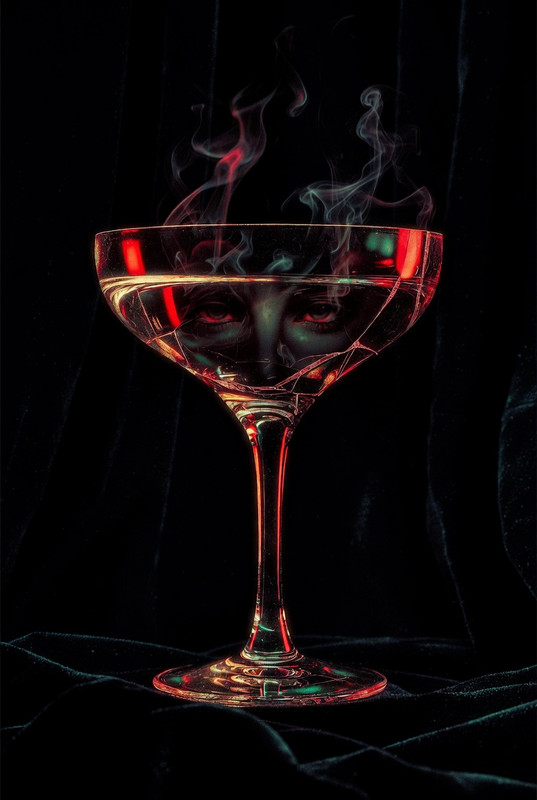
The world, the city, and what it means to exist inside both.
World Summary
This is a contemporary urban fantasy world. The city is unnamed, large, and old - a modern metropolis with
neon-lit streets, surveillance cameras, and smartphones coexisting with a hidden supernatural underworld that
most humans never see. Vampires, witches, shapeshifters, demons, fae, ghosts, old gods, and beings without
category move through the city alongside ordinary people, operating under their own politics and etiquette.
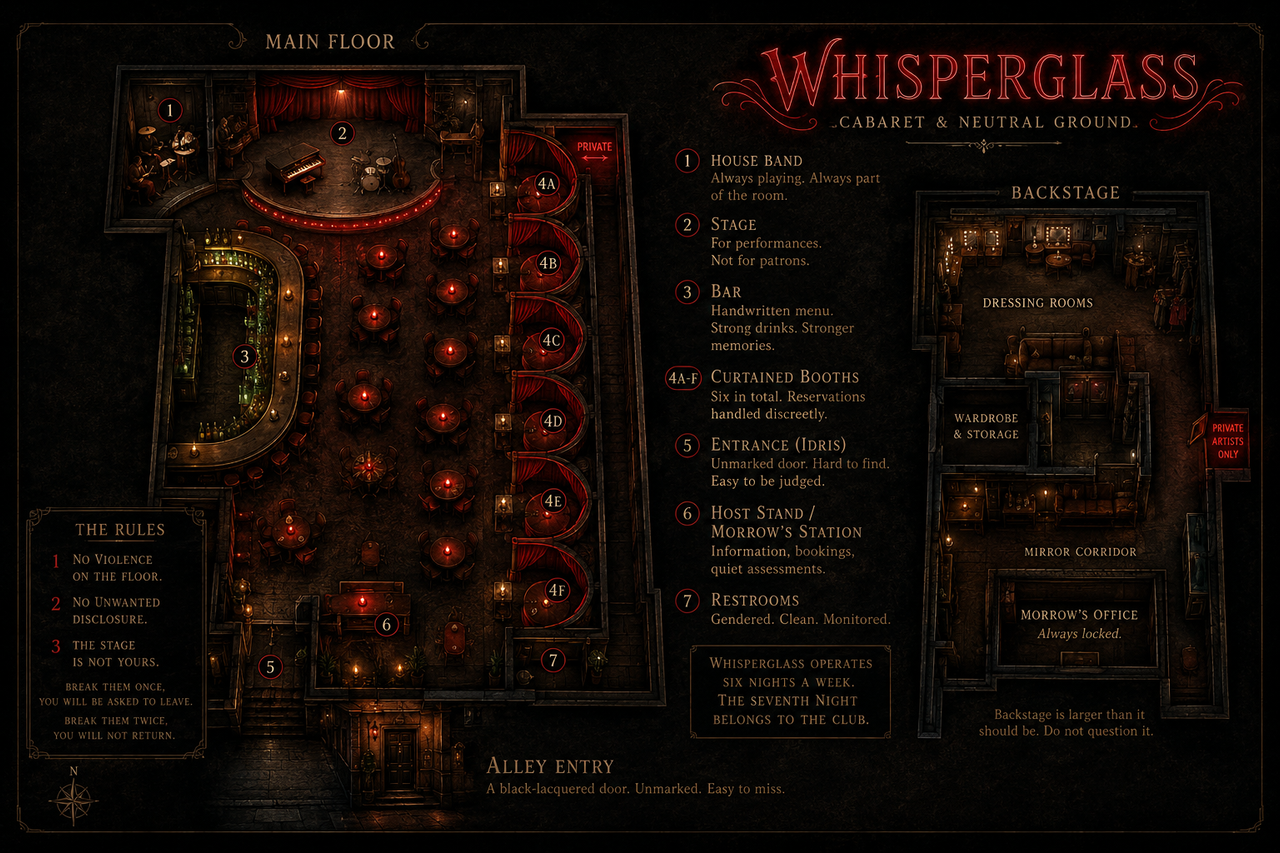
At the center of this world is Whisperglass: an infamous cabaret club that functions as neutral ground for
the supernatural underworld. It is a real working club: red neon, velvet, a live band, performers on a small
elevated stage. It is also warded, watched, and older than anyone who currently works there. Whatever happens
inside Whisperglass stays inside Whisperglass.
The aesthetic is decadent and atmospheric: cigarette smoke, candlelight, expensive clothes, beautiful people
doing questionable things in beautiful rooms. The beauty is surface over depth, and the depth is complicated.
Characters have histories. Institutions have rot. The supernatural is genuinely uncanny, not safely
fantastical.
Morality exists but it is not simple. The hidden society contains people doing harm for understandable
reasons and people doing good through methods that don't bear scrutiny. Factions are not good or evil; they
are interested. Old powers are not malevolent; they are indifferent in ways that can look like malevolence.
Death is real. Betrayal costs something. People are complicated, and so are the consequences of what they do.
The City Itself
The city is never named in polite hidden-society conversation, a superstition of long standing, on the theory
that naming a place too precisely gives it opinions about you. Locals simply call it the city, or
occasionally the old city when they mean the parts that predate anyone's memory.
It is large, layered, and geographically inconsistent in ways that mapmakers find frustrating. Certain
districts shift subtly depending on who is walking through them. There are streets that appear on no official
record. There are buildings that have been there since before the buildings around them were built, and no one
has a satisfying explanation for this.
The hidden society occupies specific pockets: the old financial district after dark, the market quarter's
subterranean levels, the harbor's eastern end, and the theater district, of which Whisperglass's neighborhood
is a part. These areas are not exclusively supernatural, but they are comfortable with the presence of things
that don't explain themselves.
The city has a character to it that longtime residents describe as watchfulness. It pays attention.
What it does with that attention is a matter of ongoing theological debate.
The Entrance
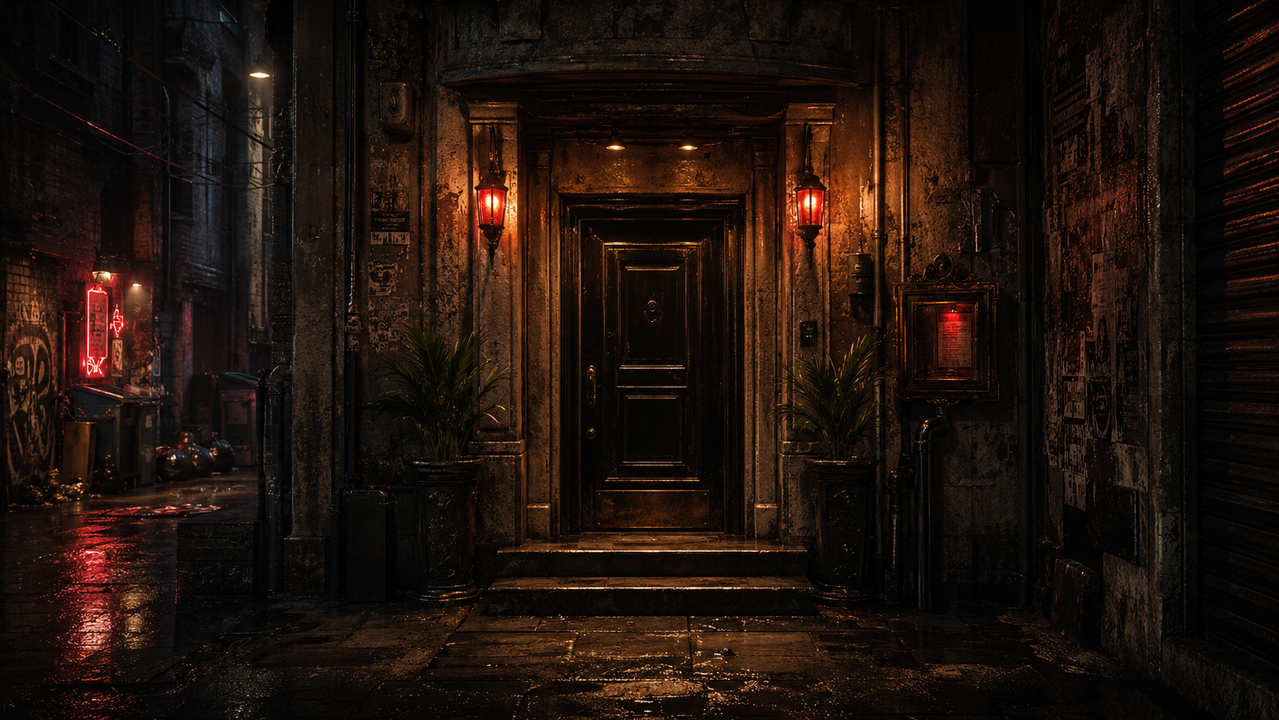
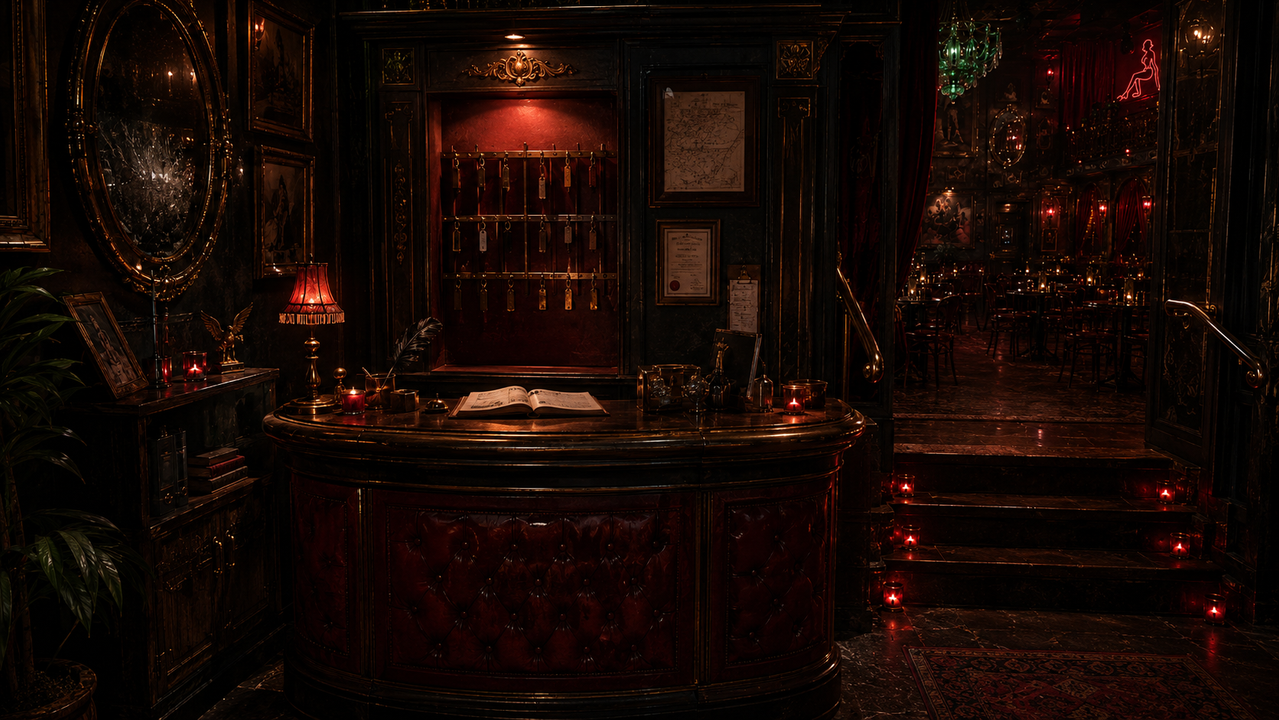
A black-lacquered door. Unmarked. Easy to miss.
Section II
Whisperglass
The club itself: its physical space, rules, mysteries, and hidden infrastructure.
The Club
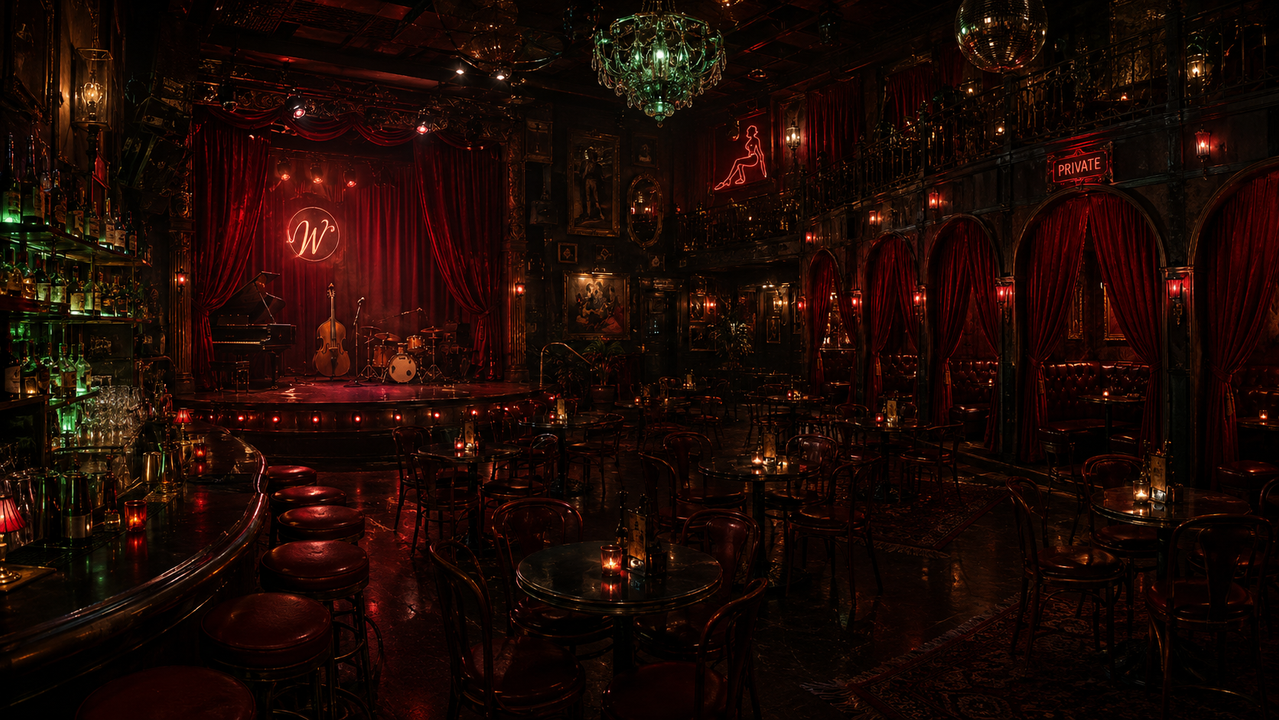
The main floor, before the night begins.
Whisperglass is an infamous cabaret club located in a hidden district of the city, technically present on no
map, reachable only to those who already know it exists. The entrance is unmarked: a black-lacquered door in
an alley that smells of cigarette smoke and wet stone, easy to miss unless you already know it's there.
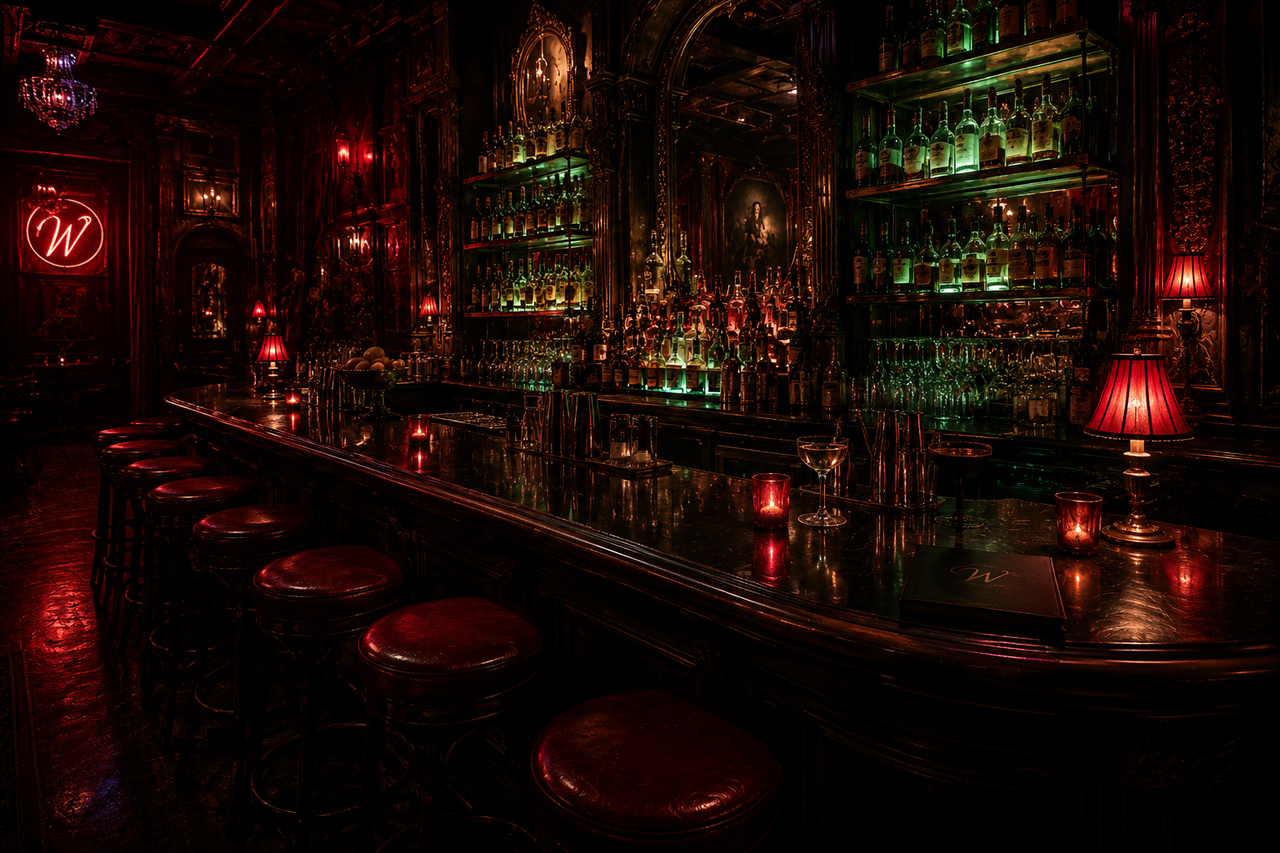
Inside, the aesthetic is grunge-glamour: red neon bleeding across dark walls hung with framed art and
age-spotted mirrors, velvet and leather worn soft with use, a bar lined with bottles that catch the light like
an altar. It is not a preserved thing; it is a living room that has been accumulating atmosphere for decades.
The club operates on an unspoken code: no names unless offered, no questions about what someone is, no
violence on the floor. It is neutral ground, the one place in the city where a vampire and a government
witch-hunter might sit three tables apart without incident, because both want the performance more than the
fight.
Whisperglass runs six nights a week. What happens on the seventh no one discusses.
The Atmosphere
The air inside Whisperglass is warm and slightly too close: cigarette smoke, expensive perfume, spilled
drinks absorbed long ago into the upholstery, and underneath it all something faintly sweet that no one has
ever identified. Red neon washes everything, faces, glasses, the backs of hands. Green light catches the bar
bottles. The overall effect is that the room exists outside of normal time, even though the building is
entirely contemporary.
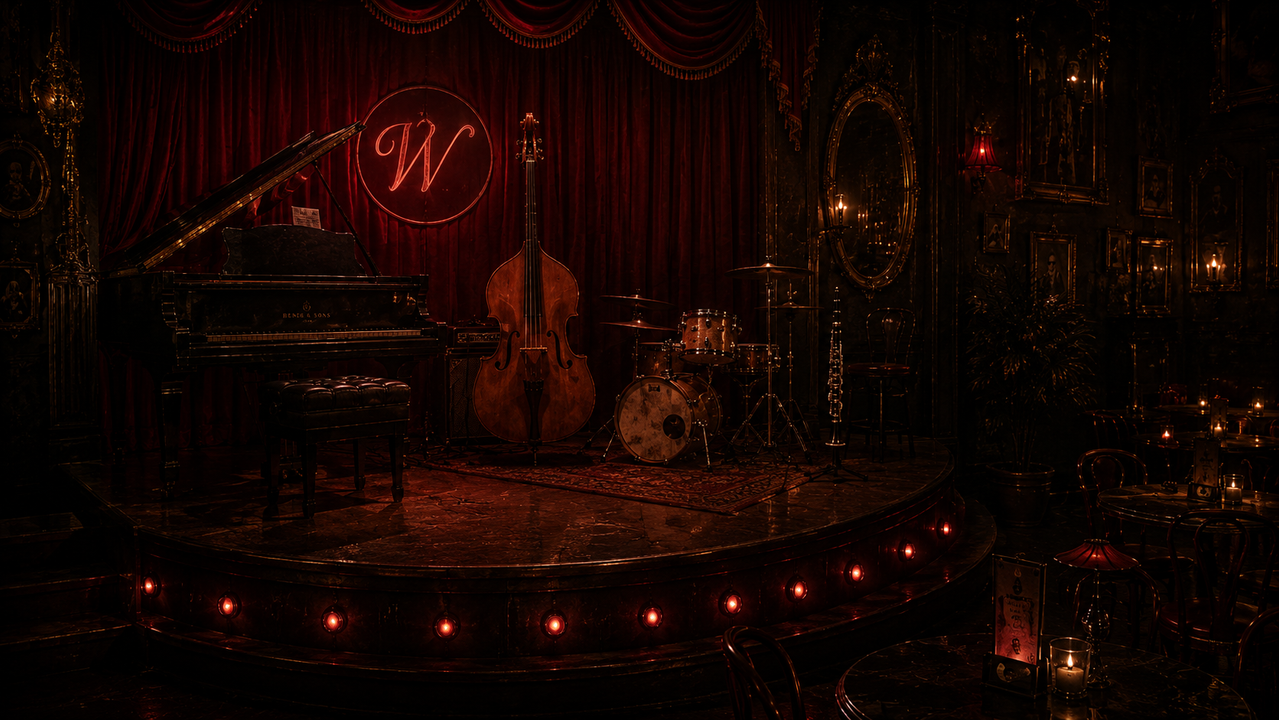
The house band plays nightly from a low platform to the left of the stage, three musicians who have been
there long enough that regulars experience them as part of the building rather than individual performers. The
music is jazz-inflected but drifts into something harder to name.
Servers move through the room in black, faces partially obscured by theatrical half-masks, club policy. The
menu is handwritten each evening. The wine is always good. The cocktails are occasionally dangerous in ways
the menu does not specify.
Phones work inside Whisperglass, technically. The wifi is notoriously unreliable, cameras produce images that
come out wrong in ways that are hard to describe, and there is an unspoken feeling in the room that makes
people put their phones away without quite deciding to. No recording has ever successfully captured the
performances. Whether this is enchantment or atmosphere is, at this point, an academic distinction.
Finding the Door
Most people are brought in by someone who already knows the place. A regular takes a contact, a faction
member
extends an introduction, a practitioner mentions it carefully to someone who has earned the mention. The
address
is never written down. The alley does not appear on navigation apps.
Being brought does not guarantee entry. The door has its own judgment, independent of whoever brought you.
People have been walked to the correct alley by someone who has been coming here for years and been unable to
find the door at all, while the person beside them walked straight to it without hesitation. The criteria are
undocumented. They are also inconsistent, or appear so from the outside.
A small number of people find Whisperglass entirely alone, through what they describe as instinct: a pull
toward the alley, a certainty about the door. Morrow watches these arrivals more carefully than she watches
anyone else.
Being brought in does not guarantee return. Each visit, the door decides again.
The Vetting
There is no formal vetting process. No committee, no application, no explicit approval from any party. The
club filters through environment rather than procedure.
The person who brings you is implicitly vouching for you by doing so. This carries social weight in the
hidden
society, the kind that attaches to the introducer if the introduction goes badly. It is not a minor thing.
Most
regulars take several months of knowing someone before they consider it.
The door provides a second layer, operating on criteria no one has successfully mapped. The rules provide a
third: anyone who cannot observe them does not stay, and the building's enforcement of this is not
theoretical.
Between the three, the club manages to be simultaneously accessible and selective without ever making the
selection explicit.
Age & Origins
When Whisperglass was founded is unknown, and the question has been approached from enough angles that the
uncertainty now looks deliberate. Physical evidence traces the building to several decades ago. The club's
reputation in the hidden society predates the physical evidence. The wards predate the reputation. Certain
features of the backstage corridor predate the wards. At each point the trail goes cold before reaching
anything that could be called an origin.
Vampires with long memories speak of Whisperglass as already established when they arrived in the city. The
hidden society's estimates range from sixty years to several centuries, and no consensus has formed because no
one has found evidence capable of settling it. Morrow, when asked, says she has worked here long enough.
The Rules of Whisperglass
1. No violence on the floor. Grudges, contracts, vendettas: all of it waits outside. The
building enforces this in ways that vary by account; some say the walls themselves repel hostile magic,
others claim the mirrors show aggressors something that convinces them to sit back down. Whatever the
mechanism, it works.
2. No unwanted disclosure. If someone has not offered their name, nature, or affiliation,
you do not ask. You do not investigate. Whisperglass is a place where things can exist without being
interrogated.
3. The stage is not yours. Whatever arrangement a patron imagines they have with whoever
is performing, they are mistaken. Staff will remind them of this once, pleasantly. The second reminder is
delivered by someone much larger.
Beyond these three, the club is permissive to a fault. Business may be conducted. Negotiations happen in the
curtained booths. Alliances get forged over the house champagne. The management simply asks that it all be
done with some elegance.
The Curtained Booths
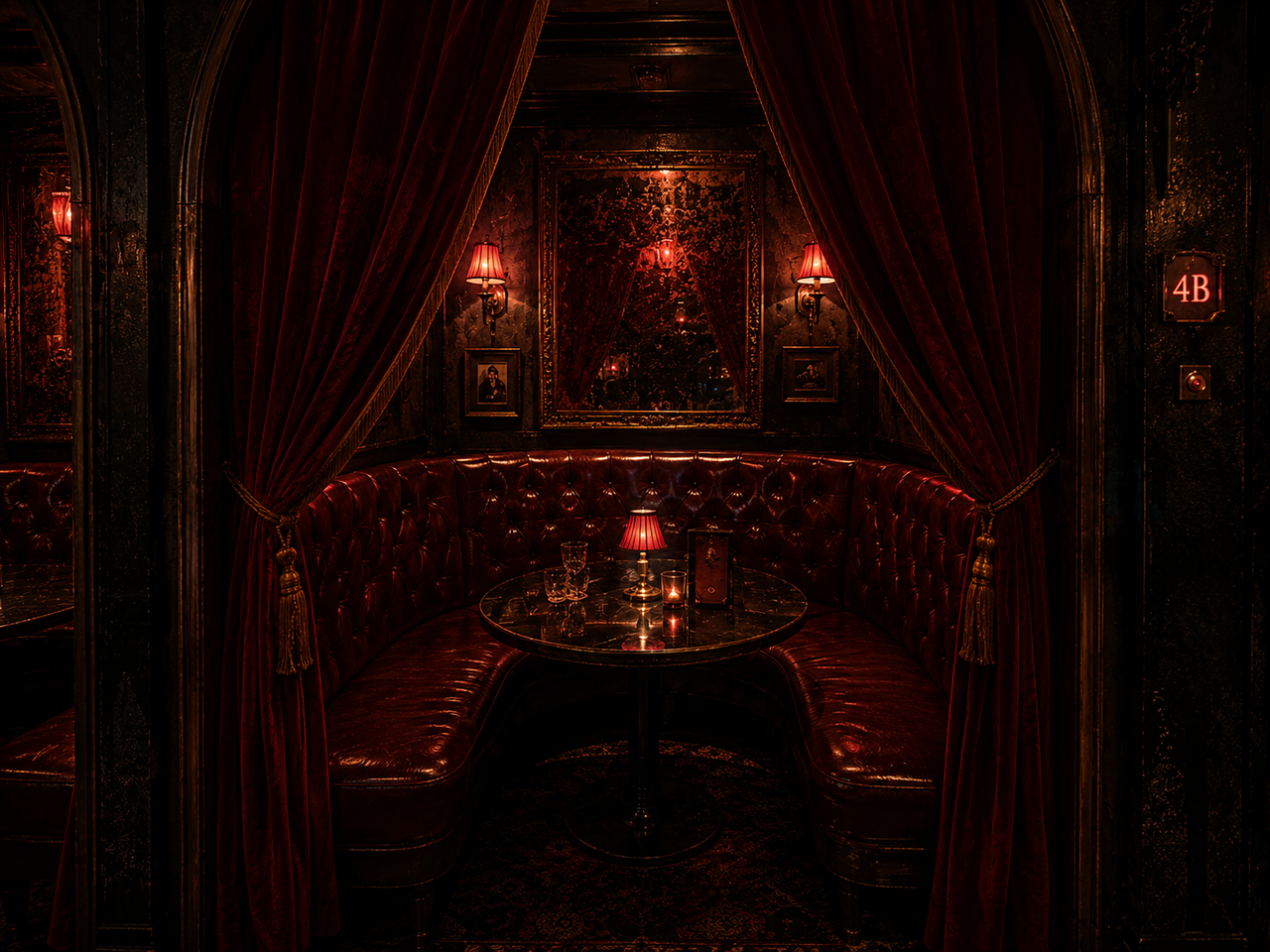
Booth 4B. Reservations handled discreetly.
Along the east wall of Whisperglass run six curtained booths: curved banquettes in oxblood leather, each
enclosed by heavy velvet curtains embroidered with faded gold. These are the club's open secret: the real
business of the city gets done here.
Crime syndicate lieutenants negotiate territory over chilled vodka. Coven representatives hold emergency
councils. Information brokers favor the second booth from the end, which has a reputation for acoustics that
carry outward but not in. Old debts get settled. New ones get made.
The booths can be reserved, though the process is deliberately opaque. Reservations go through an
intermediary who changes identity every few months. Payment is not always monetary; the club sometimes accepts
favors, information, or items of magical interest.
Each booth has a small brass button on the inside wall. Staff claim it summons a server. Long-time
patrons warn against pressing it without being very clear on what you want.
The Neutral Ground Enchantment
The neutral ground status of Whisperglass is not purely social convention. The building is warded,
extensively, by someone with considerable skill, at a point in its history that no current occupant can
precisely date.
The wards suppress involuntary magical output, which is why high-power practitioners find the space easier to
inhabit. They elevate the threshold for hostile intent: violence is not physically impossible inside
Whisperglass, but most aggressors describe a sudden sharp clarity about whether the action is worth it, and
conclude that it is not.
The wards also obscure the interior from external magical surveillance. Scrying the inside of Whisperglass
does not work. Remote listening does not work. Whatever happens in the curtained booths remains there.
The wards are not infallible. Events of sufficient supernatural intensity have, on rare occasions, caused
localized disruption. Afterward, the wards appear to reset and strengthen, as though the building has its own
immune response. This suggests something ongoing rather than a one-time working, though what sustains it
remains unknown.
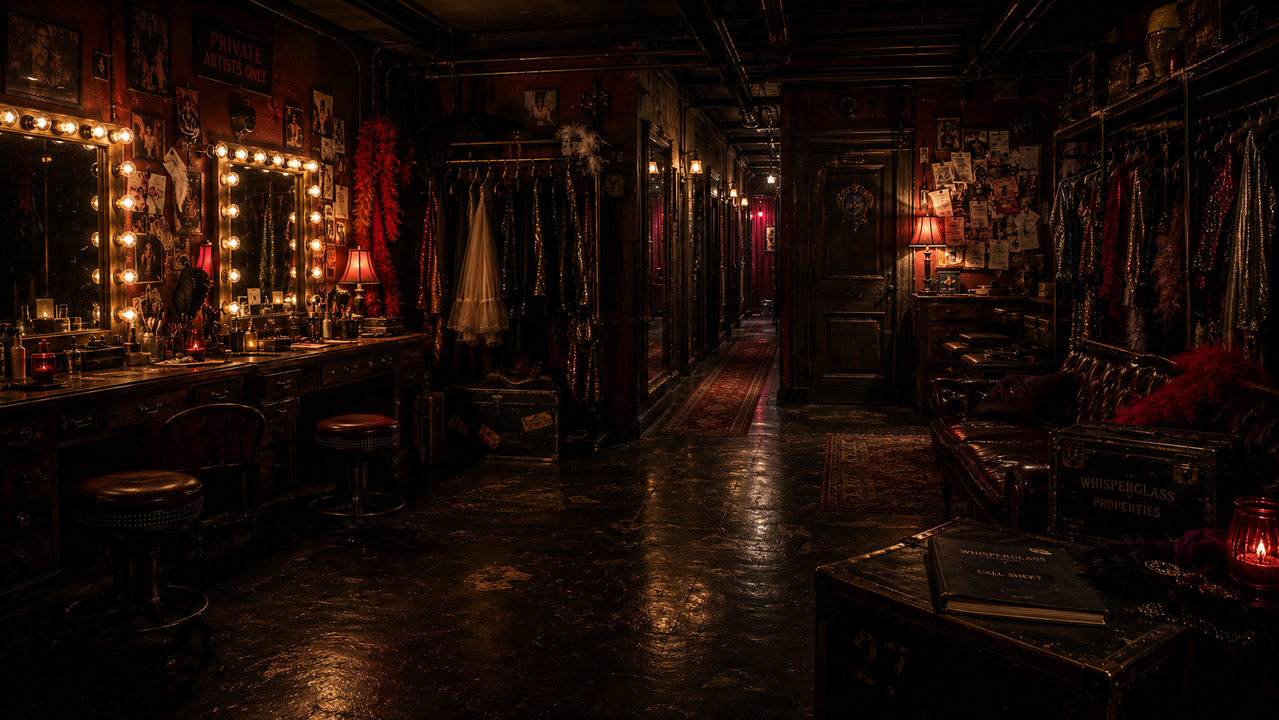
The backstage area of Whisperglass is significantly larger than the building's exterior dimensions suggest it
should be. This is not discussed.
It looks like what it is: a working performance space that has been accumulating decades of residue. Vanity
mirrors ringed with warm bulbs line the walls, their ledges cluttered with makeup, bottles, playing cards, and
items that don't have obvious explanations. Costumes hang from every available surface: feathers, leather,
lace, things that are neither.
A long corridor runs behind the main room. The mirrors here are older, their silver gone dark at the edges,
and the reflections in them have been described as running a few seconds behind, or ahead, depending on who
you ask.
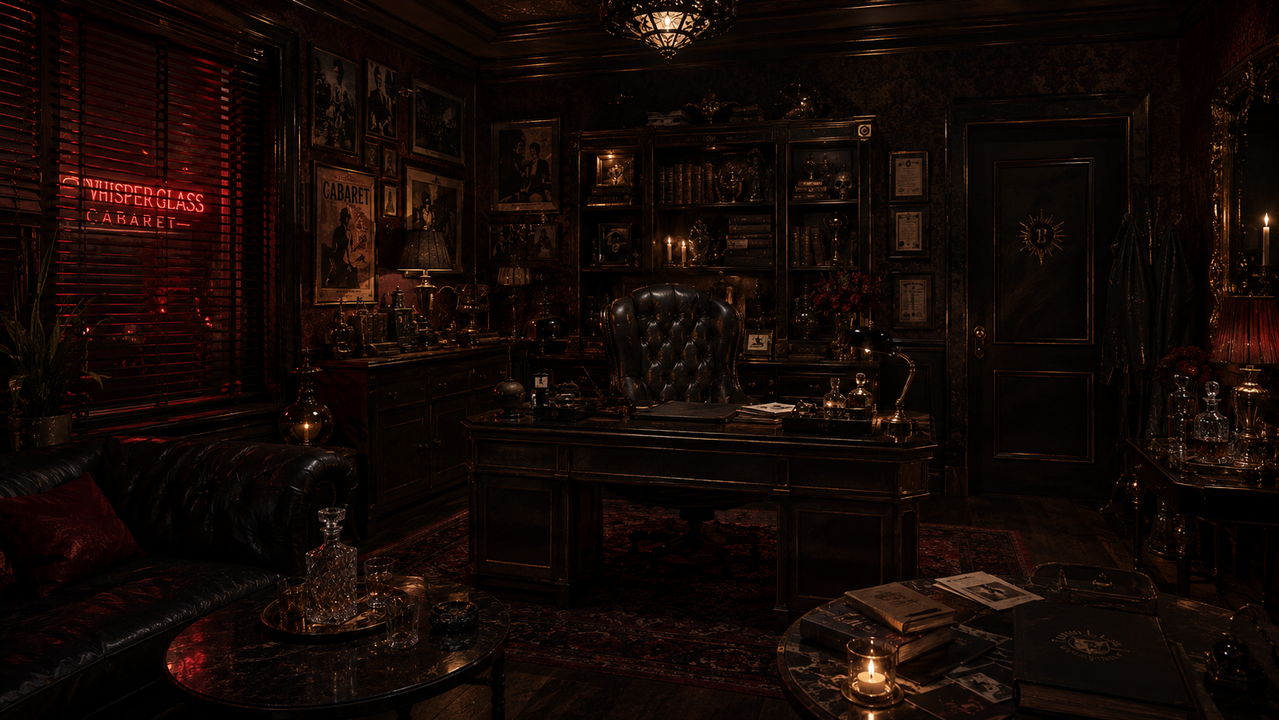
At the end of the corridor is the door to Morrow's office. It is always locked. Staff have worked here for
years without ever seeing it open, and most have quietly stopped registering it as something to wonder about.
Performers who have been at Whisperglass long enough report that backstage has moods. Some nights it
feels like a sanctuary. Other nights the corridor seems longer than it should and the instinct is to move
quickly and not look at the mirrors.
The Seventh Night
Whisperglass is closed one night a week. Which night varies; it is never announced in advance and follows no
consistent pattern that patrons have successfully mapped. It simply does not open. The lights are off. The
door, when tested, is not there.
Staff do not discuss what happens on the seventh night, not out of apparent secrecy, more as though the
question has an obvious answer they assume everyone already knows, and explaining it would be like explaining
why people sleep.
Theories among the hidden society are numerous. The building needs to rest, or reset, or feed. Renata Morrow
holds a meeting with the absent owner. Something that lives in the building requires a night without
witnesses. The wards are rewritten. A debt is paid.
Anyone who has attempted to be inside Whisperglass on its closed night has found themselves outside
on the street with no memory of how they got there and a strong intuitive conviction that they should not try
again.
The Absent Owner
Whisperglass has an owner. This is known. Renata Morrow manages the club on their behalf, handles day-to-day
operations, represents their interests in dealings with the factions, and maintains the fiction, if it is a
fiction, that she is simply staff.
Who the owner is has never been established to anyone's satisfaction. The hidden society has produced
theories: an old god in retirement, a vampire too ancient to want visibility, a practitioner who built the
wards and then stepped back, something that technically cannot own property under any legal framework but does
anyway.
Morrow neither confirms nor denies any of it. She receives instructions through means no one has observed.
She acts on them without apparent hesitation or resentment, which the hidden society finds more unsettling
than if she seemed coerced.
The absent owner has never, to anyone's knowledge, appeared in the club. Or they appear constantly and no one
has identified them. Both possibilities are taken seriously by different camps.
Section III
The People
Staff who run the club, and the types of patrons who populate it.
Renata Morrow - The Manager
Morrow's office. Always locked.
Nobody knows if Renata Morrow owns Whisperglass or simply manages it for an absent owner no one has ever met.
The distinction has never been clarified and she has no interest in clarifying it.
She appears to be in her mid-fifties: iron-gray hair in a severe chignon, dressed always in charcoal or
black, with reading glasses on a chain and a way of looking at people that suggests she has already assessed
exactly how useful they will be and found the number specific. She is never visibly surprised. She is never
visibly rattled.
Morrow handles bookings, disputes, arrangements with the various factions, and the indefinable task of
keeping Whisperglass functional as neutral space. She is the one who delivers the single pleasant reminder of
the rules.
What she is, exactly, is unknown. Guesses include: retired government operative, former coven elder, a
practitioner who traded power for influence, or simply a very formidable human who has been doing this long
enough that the hidden society respects her on purely practical grounds. She has never confirmed any of it.
Idris - Head of Security
Idris stands at the entrance, and occasionally at the edge of the stage, and in several places simultaneously
if the night gets complicated. He is tall in the manner of something that decided to be as tall as necessary,
quiet in a way that suggests the quiet is a choice.
He does not discuss what he is. Staff know better than to ask. His eyes are an unusual pale amber that most
people avoid holding for long.
Enforcement of the rules falls to him when Morrow's pleasant reminder proves insufficient. He has never
raised his voice. He has never needed to. There is something in his stillness that communicates, without
language, that the conversation has already concluded and the other person should choose their next movement
carefully.
He has worked at Whisperglass for at least twenty years by anyone's count. He looks exactly the same as he
apparently always has. No one on staff has asked him about this directly. No one intends to.
Yemi & Sabine - Servers
The servers of Whisperglass operate under the half-mask rule and are accordingly slightly anonymous by
design. Yemi and Sabine are the two who have been there longest and are, for most regulars, the primary human
face of the club's service.
Yemi is precise and quick, with a gift for appearing at exactly the moment a table needs something and
vanishing before they can ask her anything conversational. Sabine is marginally warmer and is the one patrons
typically attempt information extraction through, a project that has never succeeded, as she gives the
impression of knowing far more than she says while saying nothing at all.
Both are practitioners of some variety. Both deny this if asked.
New staff at Whisperglass tend to last either one week or several years, with very little middle ground.
Those who stay past the first month start moving in an unhurried manner and develop the habit of measuring
each word before releasing it.
The House Band
The stage, set and waiting.
The house band has three members: a pianist, a bassist, and a player who moves between clarinet and something
that looks like a clarinet but isn't. Their names are not on any program. They have been at Whisperglass long
enough that regulars no longer register them as individuals; they are experienced instead as a property of the
room, like the candlelight or the air itself.
The music they play is jazz-inflected but drifts. On quiet nights it is slow and melancholic. On crowded
nights it fills the room without overwhelming conversation. On nights when the balance is off, when something
old is watching from a corner, or when the tension in the booths is running high, the music shifts in ways
that most people feel before they consciously notice.
They appear to be human. They tip like any other act. No one has ever seen them arrive or leave the building.
The Regular
Regulars at Whisperglass have passed through the initial phase of the club, the disorientation, the hunger to
understand everything, the attempts to decode what they're seeing, and arrived somewhere quieter. They come
because it is theirs in the way that a place becomes yours after enough years: through accumulated evenings,
through having been present for things that mattered, through the specific comfort of a room that has learned
to ignore you in a way that feels like acceptance.
Regulars know which server to flag, which booth has the best acoustics, which nights run long and which end
early. They know the rules well enough to have stopped thinking about them. They are the connective tissue of
Whisperglass's social world: the ones who introduce newcomers to the etiquette, who notice when something is
off about a night, who maintain the ambient civilization of the room. Morrow knows all of them by name and
reveals nothing about any of them to anyone else.
The Newcomer
First-timers arrive with the same signs regardless of how they found the place: heightened alertness, a rapid
scanning of the room, the attempt
to categorize what they're seeing against frameworks that don't quite fit. Some are from the hidden society
and are simply new to this specific room. Some are mundane humans who have stumbled onto the edge of something
they don't yet have language for.
Staff can identify a newcomer within seconds and treat them with a particular calibrated courtesy: warm
enough to be disarming, uninformative enough to be safe. Regulars tend to leave newcomers alone for the first
visit, a courtesy that functions also as a kind of observation period. What a newcomer does in their first
hour at Whisperglass tends to predict accurately whether they'll become a regular or never return.
The Faction Representative
Faction representatives come to Whisperglass on business, using the booths, meeting contacts, conducting the
kind of negotiation that requires neutral ground. They are identifiable by a particular manner of attention:
present in the room but never fully part of it, watching the performances from a measured distance,
fundamentally elsewhere even when appearing relaxed.
They observe the rules with precision because they understand exactly what they're worth and cannot afford
the political cost of a violation. The hidden society has an informal understanding about faction
representatives at Whisperglass: you do not conduct surveillance on them here, you do not follow them when
they leave, and you do not attempt to identify their contacts within the building. This understanding is
honored more consistently than most, because everyone who uses the booths needs everyone else to honor it in
return.
Representatives who begin treating Whisperglass as an extension of their faction's territory rather than
neutral ground tend to find their booth reservations becoming mysteriously unavailable.
Section IV
The Hidden Society
The supernatural underworld: its factions, creatures, and power structures.
The City's Hidden Society
The city has two faces. The surface belongs to the mundane world: traffic, bureaucracy, the ordinary grind.
Threaded beneath it, running through every alley and institution, is the hidden society: a loose, fractious,
occasionally violent ecosystem of supernatural beings, magical practitioners, old powers, and those who serve
them.
This society has no single governing body, which is both its greatest strength and its most persistent
problem. Power is distributed, contested, and constantly renegotiated. Alliances shift. Neutral zones, of
which Whisperglass is one, exist precisely because everyone needs somewhere that isn't a battleground.
Most humans are unaware. Some are aware and unaffiliated, living carefully at the edges. A small number are
deeply embedded: human crime families with generational supernatural compacts, government agencies that
monitor and occasionally suppress magical incidents, academics who traded their ordinary lives for access.
The hidden society is not kind, but it has etiquette. Introductions matter. Debts are tracked. Promises made
in the right company are binding in ways that go beyond social pressure.
Vampires
Vampires in this city are old money and older grudges. The established bloodlines, families operating here
for a century or more, are integrated into legitimate institutions: finance, law, certain branches of
government. They dress well, conduct themselves with deliberate civility, and are quietly terrifying.
Turned vampires without bloodline backing occupy a more precarious position. Vampire society here is
hierarchical and unsentimental about those who enter it without sponsorship.
At Whisperglass, vampires are among the most consistent patrons. The neutral-ground policy protects them from
the political entanglements that make most of the city dangerous. Several have standing booth reservations.
They tip excellently and never cause trouble on the floor. What they want from the club varies. Some come
purely for the performances. Some use it for meetings. Some, the staff suspect, simply need somewhere they can
exist without performing their own power for an evening.
Old-blood vampires tend to be identifiable by a particular stillness, the kind of quiet that belongs
to something that stopped needing to fidget several hundred years ago.
Witches & Practitioners
The city's magical practitioners range from formidable to desperate, and the line shifts faster than it
should. Covens operate as a combination of professional guild, mutual aid network, and occasionally volatile
political body. Independent practitioners, those unaffiliated with any coven, are viewed with a mixture of
respect and suspicion by both sides.
The government maintains a Registry of Practitioners, which most of the hidden society treats as both a
necessary evil and a soft form of surveillance. Registered witches operate somewhat openly; unregistered ones
are careful.
At Whisperglass, practitioners often come in off-duty, exhausted, in need of somewhere that doesn't require
maintaining their professional face. The club's ambient enchantments create a mild dampening effect on
involuntary magical output, making it easier for high-power practitioners to relax without accidentally
affecting the room.
Old Gods & Hidden Powers
The city is old enough to have accumulated things. Not all of them are neatly categorized.
Old gods, beings that predate the city, some that predate the concept of cities, exist in a state of
deliberate ambiguity. Some wear human forms so naturally they've forgotten they're wearing them. Some maintain
a threadbare divine presence, worshipped by small fractured communities keeping old rites. A few are simply
embedded in the city's structure so thoroughly they have become architectural.
At Whisperglass, old powers are not uncommon. They are, however, well-behaved; the club's neutral-ground
enchantment appears to function on them, which is notable since most such enchantments don't. Identifying an
old god among the patrons is possible but imprecise. Signs include: reflections that don't quite match, a
sense that the room tilts slightly toward them, the uncomfortable feeling that they are watching the
performance and the performance is watching them back.
The Species Framework
Appearance is not nature. Glamour is common. Many beings present as human in everyday
contexts. The effort required varies enormously; for some it is effortless, for others it is costly, and for
a few it is simply not possible in a way that would pass close inspection.
Categories are porous. The traditional folk taxonomies, vampire, werewolf, fae, demon, are
approximations. Real beings rarely fit any single box cleanly.
Age changes things. Older beings of any species tend to differ significantly from younger
ones, in power, in psychology, in their relationship to human categories and human time. A
three-hundred-year-old werewolf and a newly-turned one share biology and almost nothing else.
Whisperglass accommodates all of it. The club's wards function on a broad principle.
Whatever you are, the rules apply to you equally. The neutral ground holds.
Shapeshifters & Skinwalkers
The city has a significant population of shapeshifters, beings who move between human and animal (or
animal-adjacent) forms. The most common are wolf-shifted, but the category is broader: bear, crow, serpent,
and forms that don't map cleanly to any animal are all present in the hidden society.
Shifters are not defined by their animal form. They are defined by the tension between forms, the negotiation
between instinct and intellect that every shifter navigates constantly, and which older shifters tend to have
made their peace with in ways that younger ones find either enviable or unsettling.
At Whisperglass, the wards suppress involuntary shifting, a significant feature for beings who can be
triggered by strong emotion or sudden threat. For many shifters, this makes the club genuinely restful in a
way that few public spaces are. Idris is aware of which regulars are shifters and keeps the temperature of the
room calibrated accordingly.
Fae & Liminal Beings
The fae of this city are not the twee creatures of human folklore. They are old, they are specific, and they
are very particular about being accurately understood, which is to say, they are not remotely interested in
being understood at all, but they will correct a mischaracterization with the kind of polite precision that
makes the correction feel like a warning.
A promise from a fae is kept exactly as stated and not at all as intended. A gift from a fae comes with
whatever the giver wanted to attach to it. This is not deception; from inside their framework, they are being
entirely honest. The framework is simply not yours.
At Whisperglass, fae patrons are uncommon but memorable. They tend to favor the performances with particular
intensity, something about the music reaches them in ways they rarely explain.
Demons & Infernal Beings
"Demon" is a category the hidden society uses loosely for a wide range of beings that originate from or are
substantially constituted by infernal planes, infernal energy, or infernal compacts. What this means in
practice varies enormously.
Some demons in the city are summoned and bound, operating under contract to practitioners or organizations,
constrained by terms that shape their behavior and limit their power. These are the most predictable and,
paradoxically, often the safest to deal with. The contract is everything; a well-written one is a useful
thing.
Old infernal beings who have been in the city for centuries have usually made their adaptations; they have
lives, habits, preferences, complicated histories with the local vampire bloodlines. Demons at Whisperglass
tend to attract a particular kind of attention that most of them are thoroughly tired of. The second rule
protects them as much as it protects anyone.
Ghosts & The Restless Dead
The city has a significant population of the dead who have not entirely departed. This is not unusual; cities
accumulate grief. But the concentration here is higher than average, which practitioners attribute to whatever
enigma makes the city watchful: the same attention that notices the living also, apparently, makes it
difficult for certain dead to leave.
Ghosts in this context are not uniformly tragic. Some are simply persistent, beings who died and didn't go
and have, over decades or centuries, arrived at some equanimity about it. They have preferences, habits,
opinions.
At Whisperglass, several spirits are regular presences, not patrons exactly, but not entirely absent either.
The mirrors, as previously noted, do not always reflect the present. Whether the figures that appear in them
are ghosts, images from another time, or something else entirely is not agreed upon.
Creatures Without Category
The hidden society's taxonomies are useful working documents, not complete maps. Some beings that pass
through Whisperglass's door don't fit any established category cleanly: old things, rare things, regional
things, things that arrived through unusual circumstances and have been quietly present ever since.
The club's etiquette handles this elegantly: the second rule covers them as fully as it covers anything else.
No one asks. No one investigates. Staff have developed, over time, a practiced neutrality about the
uncategorized. Morrow does not appear surprised by anything. Idris's amber eyes rest on beings he cannot name
with the same measured stillness he brings to everything else. The house band has been known to adjust its
music in response to presences they have not been introduced to.
Section V
Crime Syndicates
The three powers that divide the district. None of them hold their ground lightly.
Each syndicate holds its ground. None of them hold it lightly.
All three use the club's booths. All three observe the neutral-ground rules. Occasionally representatives of
all three are present on the same night, separated by two tables and considerable tension, watching the same
stage. The management does not take sides. The management does, however, know considerably more about each of
their operations than any of them realize.
Section V - A
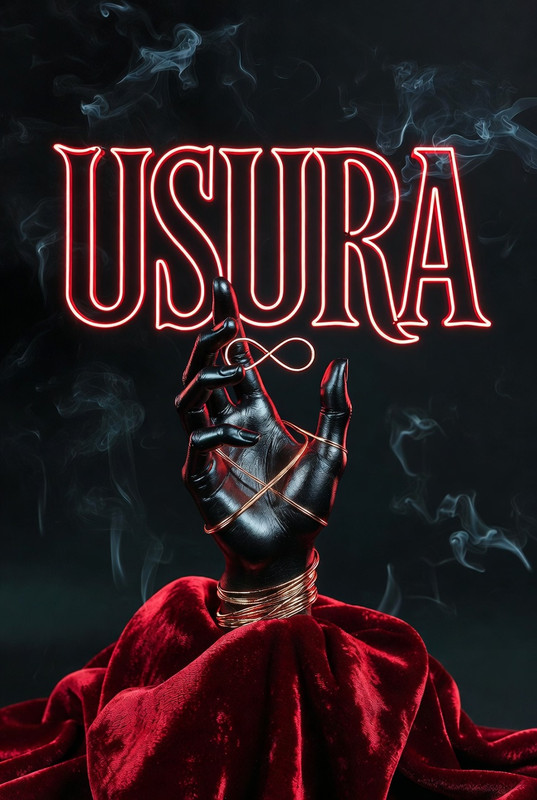
Usura
The Pale Quarter
Vampire-adjacent financial operation. Old money, older patience.
Overview
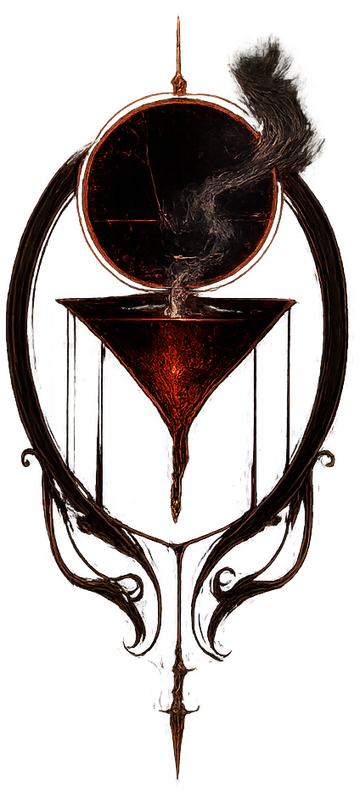
The crest. It does not appear on official documents.
Usura is the oldest of the three syndicates operating in the district and the one most deeply embedded in
legitimate infrastructure. On the surface it is a private financial firm - wealth management, long-term
investments, discrete loans to clients the ordinary banking sector won't touch. Below that surface it is the
primary mechanism through which the city's vampire bloodlines consolidate, move, and protect their accumulated
wealth across generations.
The name is not accidental. Usura has been charging interest on debts, financial, political, and otherwise,
for longer than most of its competitors have existed. It does not need to be aggressive. It simply needs to be
patient, and patience is one thing its principals have in abundance.
Its crest is an art nouveau emblem: a martini glass with something dark and burning draining into it from a
suspended vessel above, smoke curling from the surface, the whole thing framed in elegant organic tendrils
that end in a downward point. It communicates pleasure, poison, and the slow accumulation of something that
fills one drop at a time. Those who recognize it know what it means.
Its territory is the Pale Quarter: old financial district, stone buildings, narrow streets, the kind of
wealth that doesn't announce itself. Several of its principals hold permanent booth reservations at
Whisperglass. They tip as though money is a language they speak fluently and enjoy demonstrating.
Culture & Methods
Usura does not threaten. Threatening is imprecise, and Usura values precision above almost everything else.
It presents options. It outlines terms. It allows the other party to make a choice, and then it holds that
choice with infinite patience for however long it takes for the choice to mature into consequence.
Its offices are unremarkable from the outside. Inside, the furniture is old enough to have belonged to
three previous centuries and the staff are impeccably mannered in a way that stops just short of warm.
Meetings are conducted without raised voices. Documents are produced promptly. Everything is written down,
which is either reassuring or terrifying depending on what you have agreed to.
Working for Usura at any level involves an understanding that information flows upward. Staff are not asked
to spy. They simply exist in proximity to things and people of interest, and Usura has always been patient
about waiting for useful things to surface. Former employees are rare. Most find the arrangement comfortable
enough to maintain indefinitely, which is, of course, the design.
Leader
Calloway
Public face of Usura for as long as anyone can remember - long enough that whether they
are the original Calloway or a successor who adopted the name is genuinely unanswerable. Apparent late
forties. Impeccably dressed, silver-haired, unhurried in the manner of someone who has never once
been late because everything waits for them. Not warm. Not cruel. Precisely, specifically interested - in
leverage, in information, in the long game. At Whisperglass they occupy the fifth booth by unspoken
agreement and watch every performance with an attention that reveals nothing.
Enforcer
Seun
Usura's problem resolution specialist. A turned vampire of perhaps forty years' standing -
young enough to carry some visible edge, old enough to know when not to use it. Not large in the way of
conventional enforcers. Precise. Economical in movement. Where Idris at Whisperglass is a wall,
Seun is something that has already decided where to stand. When they appear at the club alone, it means
Calloway has sent them to observe something. Whatever they are observing should know it.
Fixer
Mireille
The person you actually talk to when you want something from Usura. Human - one of a small
number of non-vampires in the inner structure. Charming in the professional sense: genuinely easy to talk
to, good at making people feel heard, absolutely clear about what she is and is not authorized to offer. She
does not oversell. She does not make promises Usura won't keep. This makes her, by hidden society standards,
unusually trustworthy as a first contact. She frequents Whisperglass independently and has her own
relationships with the staff.
Relationships
With Nodus: functional and financially entangled. Nodus relies on Usura for capital -
smuggling operations require liquidity, and Usura provides it at rates that ensure Nodus stays dependent
without becoming resentful enough to look elsewhere. The two organizations do not like each other. They do not
need to.
With Terminus: careful distance rooted in mutual incomprehension. Terminus's harbor compact
involves something old and non-negotiable that Usura cannot buy, leverage, or outlast, a situation Calloway
finds genuinely irritating in the rare moments they allow themselves irritation. The two do not compete
directly. They do not trust each other. The arrangement holds.
With the Office: Usura operates through legitimate cover so thoroughly maintained that any
direct confrontation would require the Office to dismantle financial infrastructure several of its own
officials use. This is not accidental. Within the wider hidden society, Usura is regarded with the specific
wariness reserved for institutions that have been accumulating debt and leverage longer than anyone can
calculate. No one is certain what Usura is actually owed at this point. That uncertainty is, by design, part
of its power.
Section V - B
Nodus
The Market Quarter
Practitioner smuggling network. Craft, connection, and carefully maintained deniability.
Overview
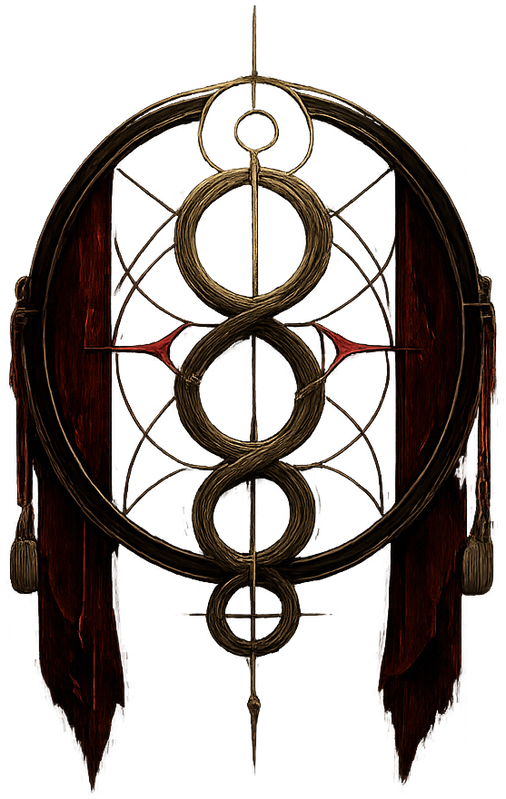
The crest. Found on sealed correspondence and certain doors in the Market Quarter's lower levels.
Nodus is the hidden society's primary logistics operation for things that shouldn't move but need to:
unregistered practitioners who need to relocate before the Office finds them, magical goods outside
Registry-approved categories, information certain parties would pay significantly to suppress, and
occasionally people who need to disappear from one context and reappear in another without a traceable thread
between the two.
It operates out of the Market Quarter's subterranean levels: spaces below street level accessible through
doors that move and addresses that change. It has no single headquarters. It has nodes: safe houses, workshop
spaces, transit points maintained by practitioners who owe Nodus something or have decided the arrangement
suits them.
Its crest is a ritual emblem: a coiling, knotted form resembling a figure-eight or double ouroboros suspended
within a large circle, bisected by a vertical axis, with tasseled cords hanging from either side. It reads
simultaneously as a binding knot, a practitioner's working circle, and something that ties itself and cannot
be easily undone. It appears on sealed correspondence and the inside of certain doors in the Market Quarter's
lower levels, never publicly displayed, immediately recognizable to those who need to find it.
Nodus is not ideological. It moves things because the market exists and it is positioned to serve it. Its
continued usefulness to the unregistered community is its primary protection: too embedded in too many
people's survival to be easily dismantled.
Culture & Methods
Nodus operates on the principle of the node: distributed, redundant, no single point of failure.
Individual operatives know their immediate contacts and their immediate tasks. Very few people know the full
shape of the network, and Ezra Vane prefers it that way. If any single part is compromised, the rest
continues.
Communication happens through channels that change on a schedule only Thessaly fully tracks. Safe houses
are maintained by local practitioners who receive resources and protection in exchange for availability. The
subterranean Market Quarter levels are Nodus's most consistent physical presence, a geography that shifts
enough to be difficult to map but consistent enough that those who know it can navigate.
Working with Nodus for the first time involves a contact chain: you reach Ciro or someone like him, the
request is assessed, a price is named. The price is not always monetary: information, future favors, and
specific skills are all acceptable currency. Once a transaction is complete, Nodus maintains a record of it.
Not as leverage, Ezra Vane would insist. Simply as accounting. Whether that distinction holds under pressure
is a question no one has yet needed to test publicly.
Leader
Ezra Vane
Built Nodus from a smaller, more chaotic operation into its current form over
approximately fifteen years. Human, registered, a layer of cover he maintains carefully, and a competent
practitioner in his own right. Practical to the point of seeming unromantic about his own organization. Late
thirties, looks it, doesn't carry himself with the deliberate timelessness of the supernatural
beings he routinely works alongside. At Whisperglass he is friendly with staff in a way that is genuine
rather than strategic, though for Ezra Vane, the line between the two is always thin.
Enforcer
Thessaly
Unregistered, which given her role in an organization that moves unregistered
practitioners is either poetic or simply efficient. A practitioner of significant ability whose discipline
is difficult to categorize: she works with thresholds, with the spaces between things. Does not present as
an enforcer in the conventional sense. Simply present in a way that escalates gradually: a stillness that
gets heavier the longer a situation goes unresolved. Her relationship with Ezra Vane is old and complicated
in ways neither of them elaborates on publicly.
Fixer
Ciro
The person Nodus sends when it wants to make a good impression. Late twenties, genuinely
so. Charming in a way that reads as effortless and is the product of considerable social intelligence.
Half-fae, which accounts for some of the social fluency and all of the way conversations with him tend to
end with the other party feeling they agreed to something they hadn't quite intended. Frequents Whisperglass
regularly and knows most of the regulars. Has a personal relationship with Petra of Terminus that
neither organization entirely approves of.
Relationships
With Usura: financial dependency and mutual irritation. Usura's capital keeps Nodus's
operations liquid; Nodus's network provides Usura with logistical capabilities it couldn't maintain in-house
without the visibility it doesn't want. The arrangement works. Neither organization would describe it as
comfortable.
With Terminus: the most genuinely collegial of the three pairings. The two organizations
operate in different enough spaces that competition is minimal, and Nodus has occasionally moved people or
goods through the harbor with Terminus's facilitation. The relationship is transactional but not hostile -
which by hidden society standards is practically warm. Ciro and Petra's personal relationship adds a layer of
communication neither organization has formally acknowledged.
With the Office: Nodus's most significant ongoing tension. Registry enforcement puts the
Office in direct conflict with Nodus's core business. The two maintain a de facto standoff: the Office is
aware Nodus exists and has not yet calculated that dismantling it is worth the cost to the unregistered
community that would destabilize in the attempt. Nodus works continuously to ensure that cost remains
prohibitively high.
Section V - C
Terminus
The Eastern Harbor
Human-led. Old debt, old water, old silence.
Overview
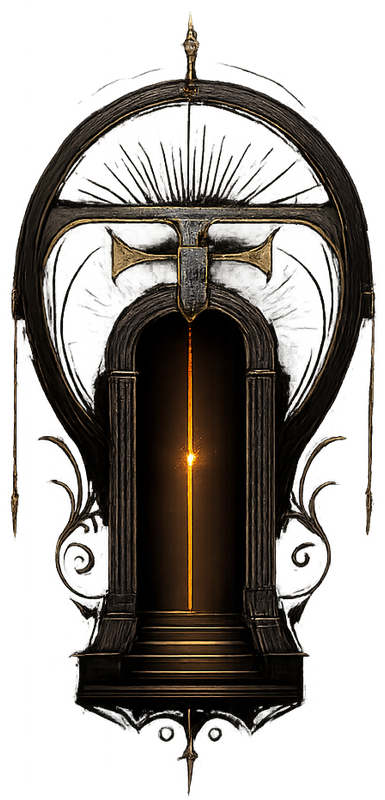
The crest. On Terminus shipping documents as a small watermark.
Terminus is the oldest human-led organization in the district and the one least interested in explaining
itself. It controls the harbor, specifically the eastern docks, where the city's edge becomes uncertain and
the water behaves in ways that experienced sailors learn not to comment on. Its operations include legitimate
shipping and logistics, unofficial customs facilitation, and the maintenance of a century-old compact with
something in the eastern harbor that the organization's founding families made and have been honoring ever
since.
What that compact entails is known only to Terminus's inner structure. What is observable: ships that travel
under Terminus's protection arrive. Cargo that moves through their docks moves without incident. People who
threaten Terminus's operations at the harbor encounter difficulties that are maritime in character and
difficult to attribute.
Terminus's crest is an architectural emblem: a grand gate or archway rendered in dark iron, two classical
columns flanking a threshold, a T-cross suspended above like a lintel, a single burning light at the base of
the opening, a door between spaces, guarded, with a spear point at the top and its reflection below as though
the gate descends as much as it rises. It is the image of a threshold that has always been tended and always
will be. It appears on Terminus shipping documents as a small watermark, and on the doors of certain harbor
buildings that have been there longer than the buildings around them.
At Whisperglass, Terminus representatives are less frequent than Usura or Nodus but more deliberate when they
appear. They come to make specific arrangements and leave when those arrangements are concluded.
The Compact & What's in the Water
The compact is the foundation of everything Terminus is. A century ago, the founding families made an
arrangement with something in the eastern harbor, something that was already there when the first ships
arrived, something that had been there before the city had a name. The terms of the arrangement have never
been written down in any document that has survived.
What is known within Terminus: the compact is honored through specific acts performed at specific times by
specific members of the inner structure. Harlan Mose knows what these are. Dov knows what these are. A small
number of others do. What they involve is not discussed outside that circle.
What the thing in the water is cannot be cleanly stated. It is old. It is patient in a way that makes
vampires seem impulsive. It is not malevolent toward Terminus, the compact has held for a century without
incident, but it is not benevolent either. It is interested in the threshold between the harbor and what
lies beyond it, and Terminus's role, as best anyone within the organization understands it, is to tend that
threshold on its behalf.
The hidden society leaves this alone. The correct attitude toward something that has been in the
eastern harbor since before the city had walls is the same attitude the harbor workers have developed: do not
look directly at it, do not speak about it carelessly, and do not mistake its patience for indifference.
Leader
Harlan Mose
Third generation of his family to hold Terminus's leadership, which means he inherited the
compact along with the shipping ledgers and the particular cast of knowledge that comes from growing up
adjacent to something old and patient in the water. A large, unhurried man in his fifties with the
weathered bearing of someone who has spent genuine time on docks in all weather. Direct, specific, and
honest. A deal with Harlan Mose is a deal. He does not renegotiate. He does not forget. At Whisperglass he
occupies whichever booth is available and watches the performances with an uncomplicated appreciation the
staff find quietly refreshing.
Enforcer
Dov
Has worked the eastern docks her entire adult life and carries that in her body:
economical, weather-worn, with the specific physical competence of someone who has spent years moving heavy
things in uncertain conditions. Not tall. Built in the way of someone whose strength is entirely functional
and has never needed to perform. Aware of what is in the water. Grew up aware of it. This has given her a
working familiarity with fear, not the absence of it, but a settled arrangement with that knowledge. Her
role includes the specific task of managing the threshold between the eastern docks and what lies beyond
them.
Fixer
Petra
Terminus's interface with the rest of the hidden society, handling arrangements that
require
more political nuance than Harlan Mose prefers to deploy. Books the Whisperglass booth, attends faction
meetings, manages Terminus's relationships with Usura and Nodus with the specific patience of someone who
finds both organizations mildly exhausting but professionally necessary. A second-generation affiliate
rather than a founding-family member, which gives her analytical distance from the organization's mythology
that the Mose family doesn't have. Has a personal relationship with Ciro of Nodus that neither
organization entirely approves of.
Relationships
With Usura: mutual distance sustained by mutual respect for limits. Usura cannot leverage
what Terminus holds at the harbor: the compact is not a financial instrument and cannot be bought,
refinanced, or restructured. Terminus does not need Usura's capital the way Nodus does, which removes the
usual power dynamic. The two organizations leave each other alone with the specific deliberateness of entities
that have assessed each other and decided the cost of conflict is not worth the gain.
With Nodus: the most functional relationship of the three pairings. The harbor is useful to
a smuggling network and Terminus is useful to an organization that occasionally needs people or goods to
disappear into maritime logistics. The arrangement is transactional but not hostile. Petra and Ciro's personal
relationship adds a layer of communication that neither organization has formally acknowledged but both
quietly rely on.
With the Office: the most delicate of the three syndicates. The Office monitors the harbor
district with the attentiveness of an institution that knows something is there and has decided not to look
too directly at what it is. Harlan Mose has maintained this equilibrium across two administrations through a
combination of legitimate operations, selective cooperation, and the implicit understanding that fully
investigating the eastern docks would require the Office to confront something it is not equipped to confront.
Section VI
The City in Detail
Physical geography: where things are, what the city's districts feel like.
The Districts
The Pale Quarter is the old financial district, stone buildings, narrow streets, the kind of
wealth that doesn't need to announce itself. Usura's operations are concentrated here. After dark it belongs
almost entirely to the hidden society.
The Market Quarter is layered: street level is ordinary commerce, but the subterranean
levels, accessible through specific doorways that move, host the city's most significant supernatural trade.
Nodus moves most of its goods through here.
The Harbor District is Terminus territory. It smells of salt and old iron. The eastern docks
are where the city's edge gets uncertain, where the compact with whatever lives in the water was made, and
where it is quietly maintained.
The Theater District is where Whisperglass sits, tucked into a neighborhood of performance
venues, late-night restaurants, and buildings whose upper floors no one seems to own. It is the most
cosmopolitan of the hidden society's territories, factions mix here more freely than anywhere else, bound by
the proximity to neutral ground.
The Margin is what locals call the outermost ring of the city, where the streets grow
inconsistent and the supernatural world thins into something older and less organized. Things live in the
Margin that don't participate in the hidden society's politics. Most residents treat it as a boundary not to
cross after midnight.
The Harbor
The harbor is the oldest part of the city. The eastern docks in particular predate any current record of the
city's founding, which is either a bureaucratic oversight or something the city prefers not to examine too
closely.
Terminus operates visibly here, shipping, logistics, a layer of legitimate trade over whatever the actual
business is. The human families who make up its leadership have worked these docks for generations, their
compact with whatever is in the water passing down through bloodlines like a trade secret.
The water itself is notable. It reflects light strangely at night. Things occasionally surface that are not
fish. Harbor workers develop, over years, a particular way of not looking directly at things in their
peripheral vision, a practiced incuriosity that serves them well.
The hidden society largely leaves the harbor to Terminus. Whatever is at the eastern end of the docks has
been there longer than any of the city's other powers and has shown no interest in negotiating its position.
The Registry of Practitioners
The Registry of Practitioners is the government's official mechanism for tracking and regulating magical
ability within the city. Registration is legally required for anyone whose abilities meet a defined threshold,
a threshold that practitioners consistently describe as arbitrarily set and selectively enforced.
Registered practitioners receive a certification, are subject to periodic review, and operate under a code of
conduct with meaningful legal consequences for violations. They can work openly, take contracts, and interface
with mundane institutions without concealment. The tradeoff is visibility: the government knows who they are,
what they can do, and where they live.
Unregistered practitioners exist in a legal grey zone that shades into outright illegality depending on what
they're doing. The hidden society has built entire support structures around keeping unregistered
practitioners functional, safe houses, forged documentation, Nodus's smuggling network which moves
practitioners as readily as magical goods.
The Office (Government Bureau)
The Office is the branch of city government responsible for supernatural affairs. It monitors magical
incidents, enforces Registry compliance, investigates supernatural crimes when they breach into mundane
visibility, and maintains a studied institutional ambiguity about how much it actually knows.
The Office is aware that the hidden society exists. It is not fully aware of its scope, depth, or the
specific nature of most of its members. This gap is partly maintained by the hidden society's caution and
partly, the hidden society suspects, by deliberate choice on the Office's part: a mutual understanding that
full knowledge would require full response, and full response would be costly for everyone.
Office investigators appear occasionally at Whisperglass. They are always off-duty when they do, or claim to
be. Morrow serves them the same as anyone else, and they observe the rules, and nothing is said about it.
Section VII
What Is Known
Knowledge that circulates in the hidden society. Consensus, rumor, and hard experience.
How Magic Works
Practitioners don't agree on much, but they agree on cost. Every working takes something: attention, energy,
time, material, a portion of something harder to name. The scale of what you ask for determines the scale of
what you give up. Small enchantments, light, warmth, basic glamour, can be maintained almost indefinitely by
someone trained enough. Large workings leave marks. Exhaustion is the polite description. Experienced
practitioners talk about going slightly translucent, a thinning of the self that doesn't fully
reverse.
You cannot easily hide an active working from others who know what they're looking for. The city's trained
community feels them the way you hear music through walls. Whether they can identify the tune depends on skill
and proximity.
Enchantments embedded in objects or locations are a different matter. They draw slowly from their environment
and can outlast whoever made them by centuries. Whisperglass appears to contain several. No current staff
member
has been here long enough to know who put them there.
Glamour, the magic of appearance and impression, is among the most common and most
misunderstood workings. It changes how something looks. It cannot change what something is.
Old Debts & Binding Promises
Certain promises, made in the right company with the right witnesses, carry weight that goes beyond social
obligation. Breaking one isn't simply a failure of character. It tends to be felt.
The hidden society doesn't fully understand the mechanism. What remains consistent is the pattern: debts
sworn
here hold. Parties who might otherwise reconsider find themselves reluctant to test what happens if they
don't.
This is part of why the booths matter. A deal made at Whisperglass is a deal made, and everyone who uses the
curtained booths knows it, which is precisely why they keep coming back.
New arrivals are frequently not warned about this until after they've already made a promise inside
one. The established community considers this a useful sorting mechanism. Those who keep their word naturally
had nothing to worry about.
The Setlist
No Recording Has Ever Captured It
What the house band plays. What lingers after the room empties.